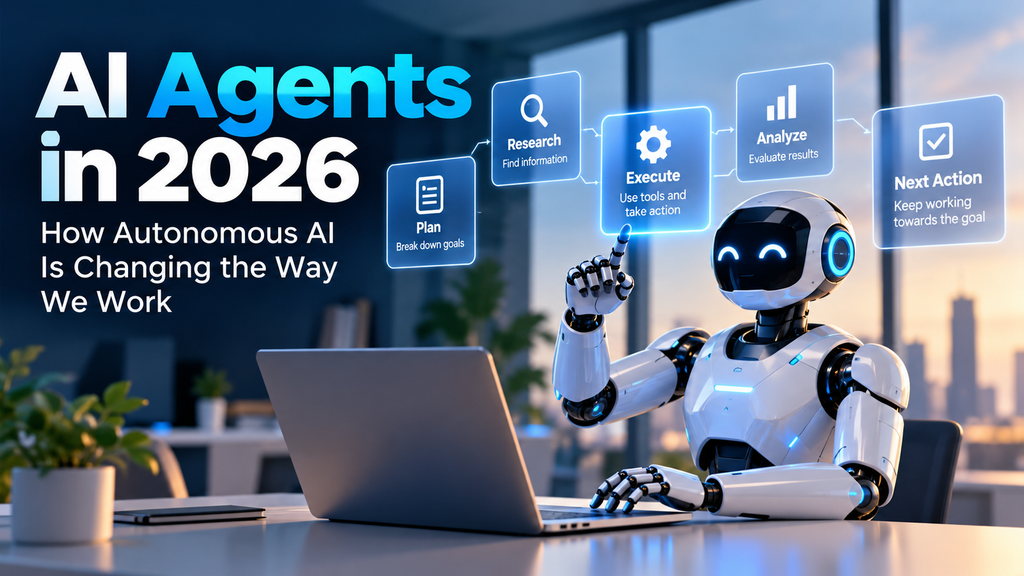
AI Agents in 2026: How Autonomous AI Is Changing the Way We Work
Meta Title: AI Agents in 2026: How Autonomous AI Is Changing Work
Meta Description: Discover how AI agents are changing work in 2026, from autonomous AI workflows to business automation, productivity, coding, and decision-making.
What Are AI Agents?
AI agents are AI-powered systems designed to complete tasks with a greater degree of autonomy than traditional chatbots and AI assistants. Instead of simply responding to a prompt, an AI agent can interpret a goal, plan a sequence of actions, use connected tools, evaluate results, and continue working toward an intended outcome.
This makes agentic AI different from a conventional chatbot. A chatbot might answer a question about a spreadsheet. An AI agent could potentially analyze the spreadsheet, identify important trends, create a report, and prepare the next action based on a defined workflow.
The growing interest in autonomous AI reflects a broader change in how organizations think about artificial intelligence. AI is moving beyond content generation and individual tasks toward systems that can participate in complete workflows.
How Are AI Agents Different From Traditional AI Tools?
Traditional generative AI tools are usually designed around a simple interaction:
Prompt → AI response → Human action
AI agents aim to support a more automated workflow:
Goal → Planning → Tool use → Execution → Evaluation → Next action
This distinction is important because the value of an AI agent is not only its ability to generate text, images, code, or analysis. Its value can come from coordinating multiple steps to achieve a specific objective.
AI Assistants vs AI Agents
| Feature | Traditional AI Assistant | AI Agent |
|---|---|---|
| Primary role | Answer or assist | Complete a defined goal |
| Workflow | Usually prompt-driven | Can be multi-step |
| Tool usage | Limited or user-directed | May use connected tools |
| Autonomy | Relatively low | Higher, within defined permissions |
| Human involvement | Often required at each step | Can be reduced for routine workflows |
| Best use | Questions and individual tasks | Complex, repeatable processes |
AI agents do not necessarily eliminate human involvement. In many business environments, the most useful model is human-in-the-loop AI, where people approve important decisions while agents handle repetitive execution.
Why Are AI Agents Becoming More Important in 2026?
The rise of AI agents is closely connected to a shift in how businesses approach automation.
Earlier AI adoption often focused on individual use cases such as writing emails, summarizing documents, generating marketing copy, or answering customer questions. Those applications remain useful, but organizations are increasingly interested in connecting AI capabilities across multiple steps.
AI Is Moving From Assistance to Execution
A traditional AI assistant can make an employee faster. An AI agent can potentially take responsibility for a defined sequence of tasks.
For example, a sales workflow might involve:
- Finding relevant leads.
- Researching company information.
- Organizing lead data.
- Drafting personalized outreach.
- Updating a CRM.
- Flagging responses for a sales representative.
The agent does not need to perform every step independently to create value. Even partial automation can reduce repetitive work and allow employees to focus on activities requiring judgment, relationships, and expertise.
Where Are AI Agents Being Used?
AI agents can be applied across many business functions. The most appropriate use depends on the organization’s workflow, data, tools, and risk tolerance.
1. Customer Service AI Agents
Customer service AI agents can help manage repetitive support tasks, such as answering common questions, retrieving information, classifying requests, and routing complex issues to human employees.
A more advanced agentic workflow could combine customer information, knowledge bases, ticketing systems, and internal processes.
The key advantage is workflow coordination rather than simply generating a response.
2. AI Agents for Software Development
AI coding agents are becoming an important area of agentic AI development. Instead of only suggesting a line of code, an AI coding agent can be designed to work across a broader development task.
A development workflow might include:
- Understanding a coding requirement
- Creating or modifying files
- Running tests
- Identifying errors
- Revising the implementation
- Reviewing the result
Human developers still play an important role, particularly for architecture, security, code quality, and production decisions.
3. AI Agents for Marketing
Marketing teams can use AI agents to coordinate repetitive activities across research, content production, campaign analysis, and reporting.
For example, an agent could help organize campaign data, identify performance changes, prepare a summary, and recommend areas for human review.
However, marketers should distinguish between automating execution and automating strategy. Brand positioning, audience understanding, creative judgment, and major business decisions still require appropriate human oversight.
4. AI Agents in Business Operations
Operations teams often manage processes involving multiple applications and repetitive decisions. This makes operations a natural environment for AI workflow automation.
An AI agent could potentially coordinate tasks such as data collection, document processing, status updates, internal notifications, and routine reporting.
The strongest opportunities are usually workflows that are repetitive, measurable, and governed by clear rules.
What Are the Benefits of Autonomous AI?
The potential benefits of autonomous AI go beyond saving time on individual tasks.
Increased Productivity
AI agents can handle repetitive parts of a workflow, allowing employees to spend more time on higher-value work.
Faster Workflow Execution
When several tasks can be coordinated automatically, organizations may reduce delays between individual process steps.
Greater Scalability
A well-designed automated workflow can potentially handle increasing volumes without requiring every step to be performed manually.
More Consistent Processes
Agent-based workflows can follow predefined instructions and procedures, helping organizations standardize routine activities.
However, these benefits depend on implementation quality. AI agents can also introduce new operational risks if they are given inappropriate permissions, poorly defined objectives, or unreliable information.
What Are the Risks of AI Agents?
The greater autonomy of AI agents creates a different risk profile from conventional AI assistants.
Accuracy and Hallucination
An AI agent can make an incorrect interpretation or generate an incorrect output. If that output triggers another automated action, the error can potentially propagate through the workflow.
Security and Permissions
Agents that can access business systems need carefully designed permissions. An organization should determine what an agent can read, change, approve, or execute.
Lack of Human Oversight
Not every decision should be automated. Financial transactions, legal decisions, sensitive customer actions, security operations, and other high-impact activities may require stronger human review.
Unexpected Actions
A system optimized to complete a goal may take an action that technically satisfies its instructions but does not match the organization’s broader intent.
This is why AI agent governance is becoming an important part of responsible AI implementation.
How Should Businesses Start Using AI Agents?
Organizations do not need to automate an entire department to benefit from agentic AI.
Step 1: Identify a Repetitive Workflow
Start with a process that occurs frequently and contains clearly defined steps.
Step 2: Define the Agent’s Objective
The agent should have a specific goal rather than a vague instruction such as “improve operations.”
Step 3: Set Clear Permissions
Define which systems, tools, files, and data the agent can access.
Step 4: Add Human Approval
Use human checkpoints for decisions where mistakes could create significant financial, legal, security, or reputational consequences.
Step 5: Measure the Results
Track meaningful outcomes such as completion time, error rates, human intervention, cost, and task quality.
The Future of AI Agents
The biggest change created by AI agents may not be a single new AI application. It may be the redesign of how work itself is organized.
Instead of employees manually moving information from one application to another, organizations can increasingly connect AI systems, software tools, databases, and business processes into coordinated workflows.
This does not mean that every job will become fully autonomous. In many cases, the more realistic future is collaborative intelligence, where humans define objectives, provide judgment, manage exceptions, and remain accountable while AI agents execute appropriate parts of the workflow.
What Businesses Should Watch Next
Organizations evaluating AI agents should pay attention to:
- Agent reliability and evaluation methods
- Security and permission controls
- Integration with existing software
- Data quality and access
- Human approval workflows
- Monitoring and auditability
- Cost of running agentic workflows
- Compliance and privacy requirements
The organizations that benefit most may not be those that automate the most tasks. They may be the ones that identify the right tasks to automate while maintaining appropriate human control.
Final Thoughts
AI agents in 2026 represent a shift from AI that responds to AI that can participate in workflows. Traditional AI assistants remain valuable for answering questions and generating content, but agentic AI expands the possibilities by combining reasoning, tool use, planning, and execution.
For businesses, the opportunity is significant—but so is the need for thoughtful implementation. The best starting point is a narrow, measurable workflow with clear objectives, controlled permissions, human oversight, and defined success criteria.
Rather than asking, “How can we replace this entire process with AI?” a better question is:
“Which part of this workflow can an AI agent perform reliably, and where should a human remain in control?”
That question creates a more practical path toward useful and responsible AI automation.